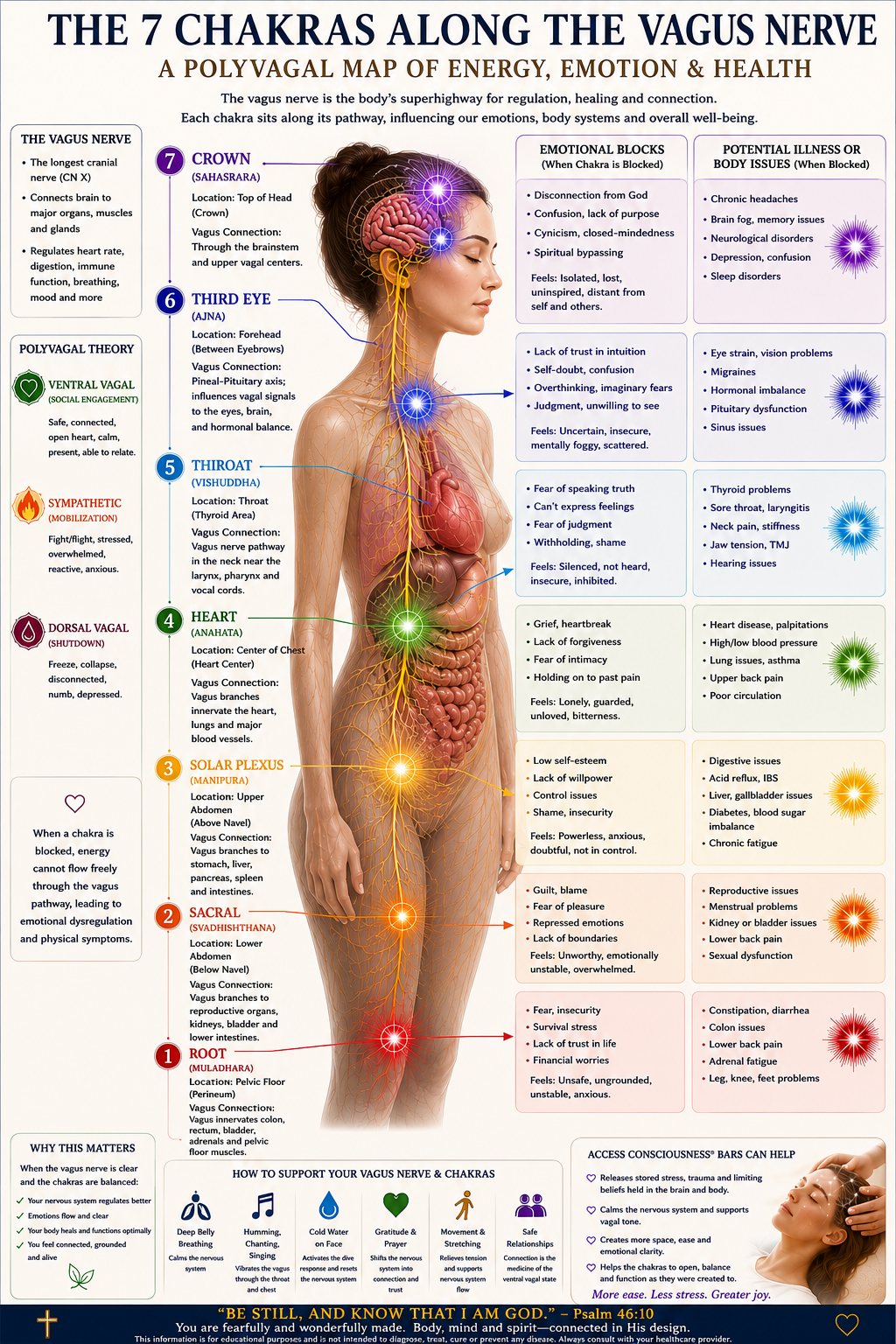
Different Language. Same Body. Why Some Christians Need a More Mature Conversation About Energy, Chakras, and Nervous System Healing
One of the most important distinctions Christians need to make in conversations about chakras, meridians, energy work, and body-based healing is this: are we talking about spiritual worship, or are we talking about human physiology being described through unfamiliar language? Those are not the same question, yet modern conversations often collapse them together too quickly.
Many Christians become understandably cautious when they hear words such as “energy,” “chakras,” or “blocked flow,” because those terms are often attached to broader spiritual systems that do not align with Christian theology. That concern is valid. Discernment matters. Christians should not casually absorb every worldview attached to a healing practice simply because it sounds peaceful or restorative. However, discernment is not the same thing as fear. Fear rejects language before understanding what the language is attempting to describe. Discernment slows down long enough to ask deeper questions.
What is actually being claimed here? What is the underlying mechanism being observed? Is this a spiritual practice requiring allegiance or worship, or is this an attempt to describe physiological experiences humans have observed for thousands of years? Can body-based observations be separated from the spiritual frameworks historically attached to them? Those are the kinds of mature questions this conversation requires.
A map is not the same thing as the territory itself. Ancient systems created maps of the body based on observation long before modern neuroscience existed. They noticed grief affected the chest. Fear affected digestion. Shame altered posture. Suppressed emotion impacted breath, tension, sleep, pain, and vitality. They lacked MRI technology, vagus nerve research, endocrinology, trauma science, or modern stress physiology; and therefore, described these experiences using the conceptual language available to them at the time.
Today, modern science gives us different terminology for many of the same observable human experiences. What one ancient system may have described as blocked energy, another modern practitioner may now describe as chronic sympathetic activation, autonomic dysregulation, reduced vagal tone, fascial restriction, disrupted interoception, inflammatory overload, or prolonged stress adaptation.
Different language.
Same human body.
This does not mean every ancient explanation was scientifically accurate. Nor does it mean every modern wellness practice is spiritually neutral or automatically beneficial. It simply means we should be cautious about dismissing all body-based observations simply because another culture attempted to describe them using unfamiliar terminology. Ancient people may not have understood the vagus nerve scientifically, but they clearly understood that stress, emotion, breath, touch, posture, safety, and connection profoundly impacted human wellness. Modern neuroscience is increasingly confirming that they were observing something real, even if their explanatory frameworks differed from ours.
From a Christian perspective, this matters because Christianity itself is deeply embodied. The body is not spiritually irrelevant in Scripture. God formed Adam from the dust. Jesus entered humanity through a physical body. He touched people. He wept. He rested. He experienced anguish, exhaustion, hunger, pain, and physical suffering. The resurrection itself was bodily. Throughout Scripture, emotional and spiritual realities are repeatedly connected to physical experience: fear affects the heart, anxiety burdens the body, grief weakens the bones, peace calms the spirit, joy strengthens health, and hope sustains endurance.
Human beings are not simply minds carrying around disposable flesh. We are integrated beings. Body, mind, emotion, relationship, nervous system, and spirit continuously influence one another. This is one reason why prolonged emotional distress eventually becomes physiological. Chronic stress is not merely a thought problem. It alters hormone regulation, breathing patterns, digestion, immune function, inflammation, pain sensitivity, sleep quality, muscle tension, emotional regulation, and cognitive clarity. The body does not politely separate emotional experiences from physical ones nearly as much as modern Western culture once assumed.
The vagus nerve is one of the clearest examples of this integration. Extending from the brainstem through major organs of the body, it functions as a communication network influencing heart rate, digestion, breathing, inflammation, emotional regulation, and social engagement. It plays a central role in how the body shifts between survival states and restorative states. When a person lives under chronic stress, unresolved grief, trauma, hypervigilance, or emotional suppression, the nervous system adapts accordingly. Over time, survival stops feeling temporary and begins feeling normal.
This is why so many burned-out individuals eventually say, “I don’t even feel like myself anymore.” Their nervous systems have adapted to prolonged stress exposure. The body becomes conditioned toward vigilance, tension, emotional constriction, exhaustion, and protective guarding. Eventually, the body stops whispering politely. It begins communicating through insomnia, digestive disruption, panic symptoms, migraines, chronic pain, emotional flatness, brain fog, fatigue, shallow breathing, inflammatory conditions, and overwhelm.
This context also explains why touch-based therapies can feel surprisingly powerful for many people. Massage therapy, cranial sacral work, EFT tapping, acupressure, somatic regulation work, and practices such as Access Bars may differ significantly in theory, terminology, and tradition, but many share one physiological principle: they create conditions that allow the body to experience safety, stillness, grounding, and regulation.
When the nervous system begins perceiving safety rather than threat, breathing often deepens naturally. Muscle tension softens. Heart rate slows. Stress hormones decrease. Emotional processing may become more accessible. Sometimes people unexpectedly cry during or after massage or relaxation therapies, not necessarily because something mystical occurred, but because the nervous system finally stopped using all of its energy maintaining protective tension patterns. The body finally feels safe enough to release what it has been bracing against.
This is one of the places where some Christians need greater nuance and intellectual maturity in these conversations. Not every calming practice is occult. Not every body-based therapy is spiritual worship. Not every mention of “energy” means someone is abandoning God. At the same time, not every wellness trend should be accepted uncritically either. Mature discernment requires the ability to distinguish between physiological observation and spiritual ideology rather than collapsing them together indiscriminately.
Modern medicine itself uses invisible concepts constantly. Electrical impulses, neural signaling, biochemical communication, magnetic imaging, neurotransmission, vibrational frequency, and energetic exchange all describe realities that cannot be visually observed with the naked eye, yet no one considers those concepts inherently mystical. The human body itself is an extraordinarily sophisticated electrical communication system. Understanding this does not diminish God. If anything, it increases awe toward the complexity of His design.
While you may occasionally hear me use terms such as “Reiki,” what I am more accurately describing within my own practice is the use of gentle touch therapy, calming sensory inputs, nervous system awareness, and restorative environments designed to help the body shift into parasympathetic dominance — the body’s “rest and digest” state where relaxation, emotional processing, regulation, and restoration become more accessible. While traditional Reiki frameworks include spiritual concepts such as “universal life force energy,” my own approach intentionally separates physiological nervous system support from the religious or spiritual rituals historically associated with those traditions. In many ways, this reflects the broader point of this article: human beings across cultures often observed the same stress-response patterns within the body long before modern neuroscience existed. The language differed. The human physiology did not.
For me personally, studying the nervous system, trauma science, fascia research, emotional regulation, and the body’s restorative capacities has not pulled me further away from faith. It has deepened it. The more I understand the intricate interplay between stress, safety, emotion, touch, and physiology, the more astonishing the human body appears to me.
This is ultimately why I do the work I do.
I work with many exhausted, emotionally overwhelmed people whose bodies have spent years adapting to caregiving, chronic stress, grief, over-responsibility, emotional suppression, trauma, hypervigilance, burnout, and survival-based living. Many of them are not weak. Many are not lazy. Many are not spiritually failing. They are physiologically overloaded. Their nervous systems have been functioning in protection mode for so long that calm itself feels unfamiliar.
I believe people need education about their nervous systems. I believe they need compassionate human connection. I believe safe touch matters. I believe calming environments matter. I believe emotional honesty matters. I believe the body possesses extraordinary restorative capacity when given safety, support, rest, and regulation.
Perhaps one of the great tragedies of modern life is that many people have become so disconnected from their own bodies that they no longer recognize the signals of distress until collapse finally forces them to pay attention.
Perhaps understanding the body more deeply does not pull us further from God.
Perhaps it helps us better understand the brilliance of what He created.